

🔍 ChatGPT rewrote how it gathers information on 8 August
On 8 August ChatGPT changed how it searches. You would not have noticed anything in the UI. The change is in how it finds sources.
We track fan-out queries at Obsero, so we saw it happen in the data rather than in a changelog. The first signs filtered through on 7 August. By the 8th it was everywhere.
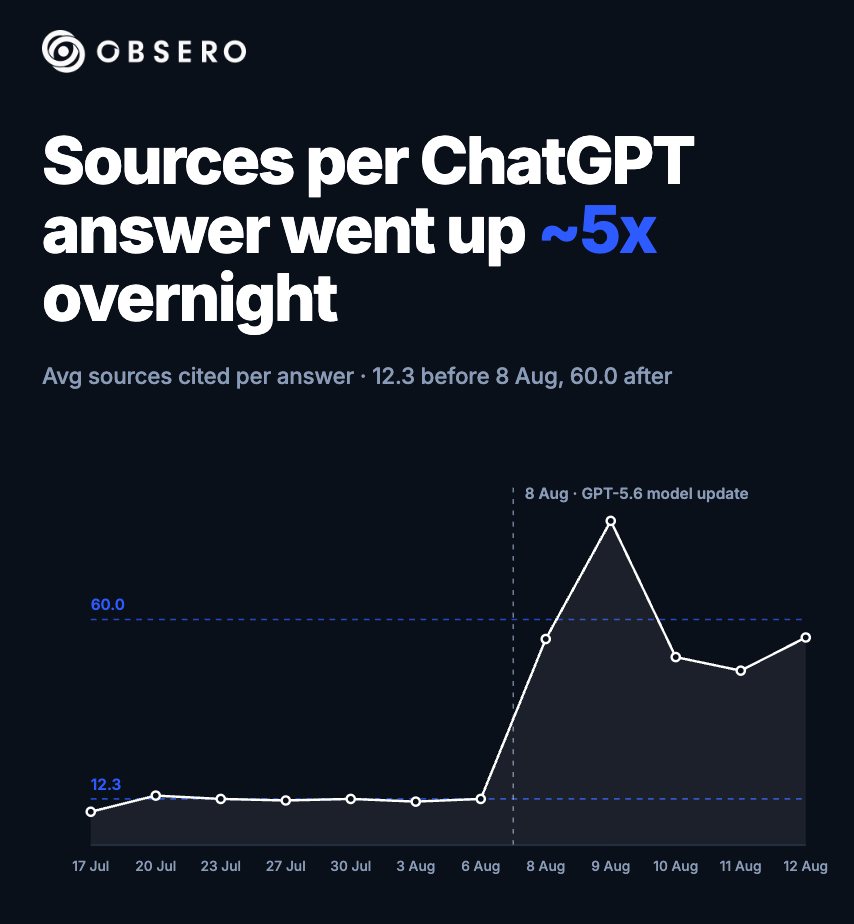
One model update, and ChatGPT went from browsing the open web to checking a shortlist of domains it already trusts.
Answers went from citing about 12 sources to about 60. And a third of the answers we assessed started going directly to specific, named websites.
If you work in PR, GEO or organic growth, this one is up your street.
First, what a query fan-out actually is
When you give ChatGPT a prompt, it does not run one search.
It breaks your prompt into several sub-queries, runs each one through a search engine, and pulls documents back from the results.
Ask for "best fitting jeans for women" and it searches price, comfort and fit as separate queries, then gathers sources for each to build the answer. Commerce prompts get their own shopping fan-outs on top of that.
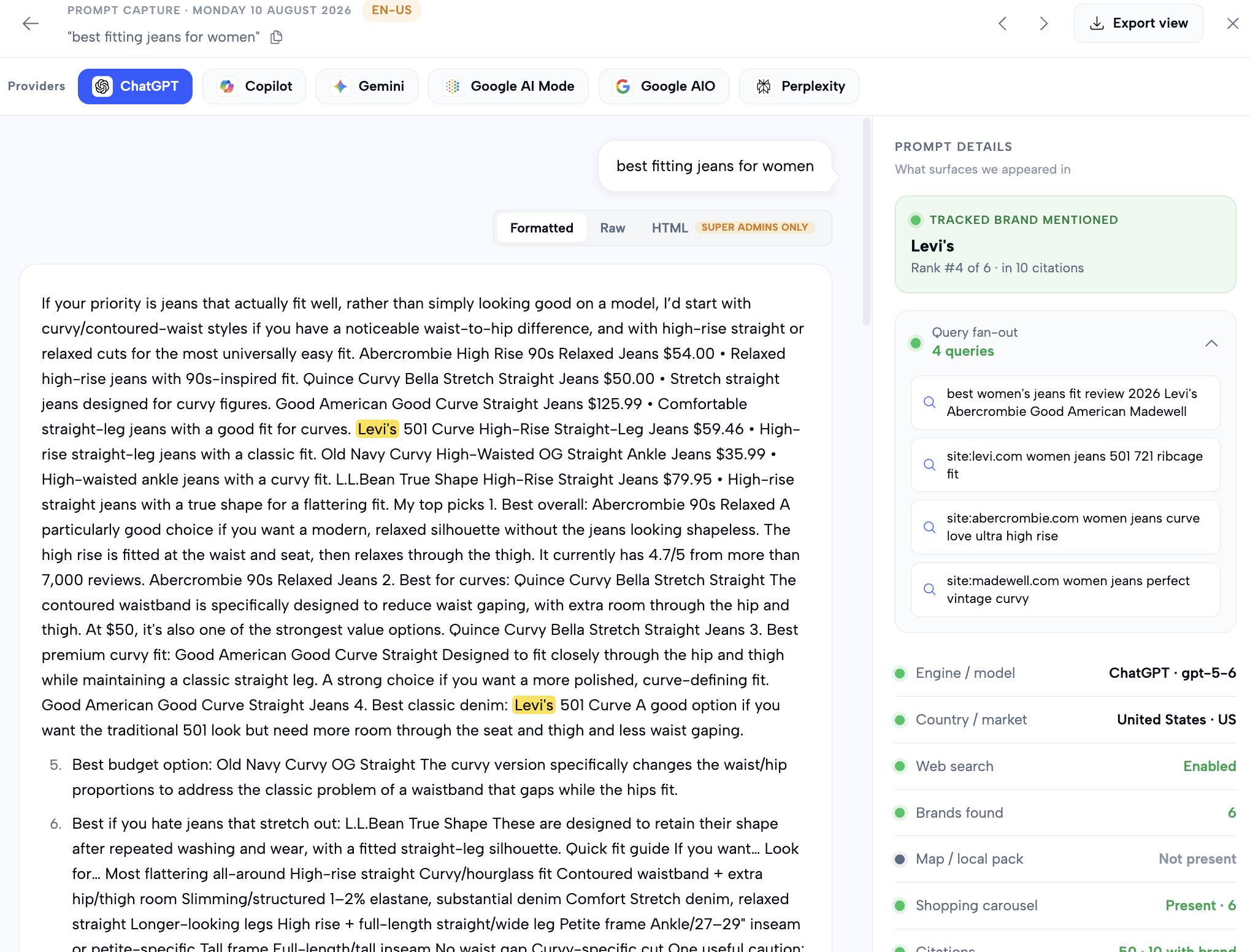
One prompt, four hidden searches, and Levi's coming out fourth of six brands in the answer. Captured in Obsero on 10 August. Click to enlarge.
You never see any of this. A brand can still make the answer without one of these searches. What the fan-out decides is which brands get checked directly, and how much ChatGPT can say about them.
What actually changed
OpenAI released GPT-5.6 Sol last week. The announcement talked about "more reliable facts" by "better using the sources it finds". We can go further than timing on this. Every answer we capture records the model that served it, and the behaviour splits on the version. The answers before are 5.5. The answers after are 5.6.
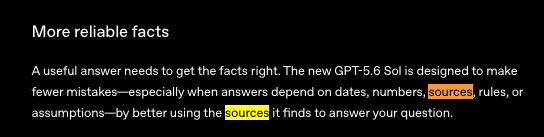
OpenAI's GPT-5.6 Sol announcement. Better use of the sources it finds, and nothing on what that would do to retrieval. Click to enlarge.
Two things changed.
Sources per answer went up roughly 5x. From around 12 to around 60.
And the site: operator started appearing in fan-outs. SEOs have used site: for years to check which pages Google has discovered on a domain. (Before any SEO corrects me, that is not the same as what is indexed. Search Console is the place for that.)
Before 8 August, ChatGPT 5.5 barely touched it. Since then it turns up in 37% of answers that have fan-outs.
In plain English: ChatGPT went from taking whatever the open web handed it to working off a shortlist of sources it already trusts, and going to them by name. That trust is decided upstream, in the training data.
Remember: this is ChatGPT only. We ran the same prompts across Google AI Overviews, AI Mode, Gemini, Perplexity and Copilot over the same window. Source numbers were flat. Nothing moved anywhere else.
READER FEEDBACK
Which AI visibility tool do you actually use?
So what is actually driving the extra sources?
Not site:, as it turns out.
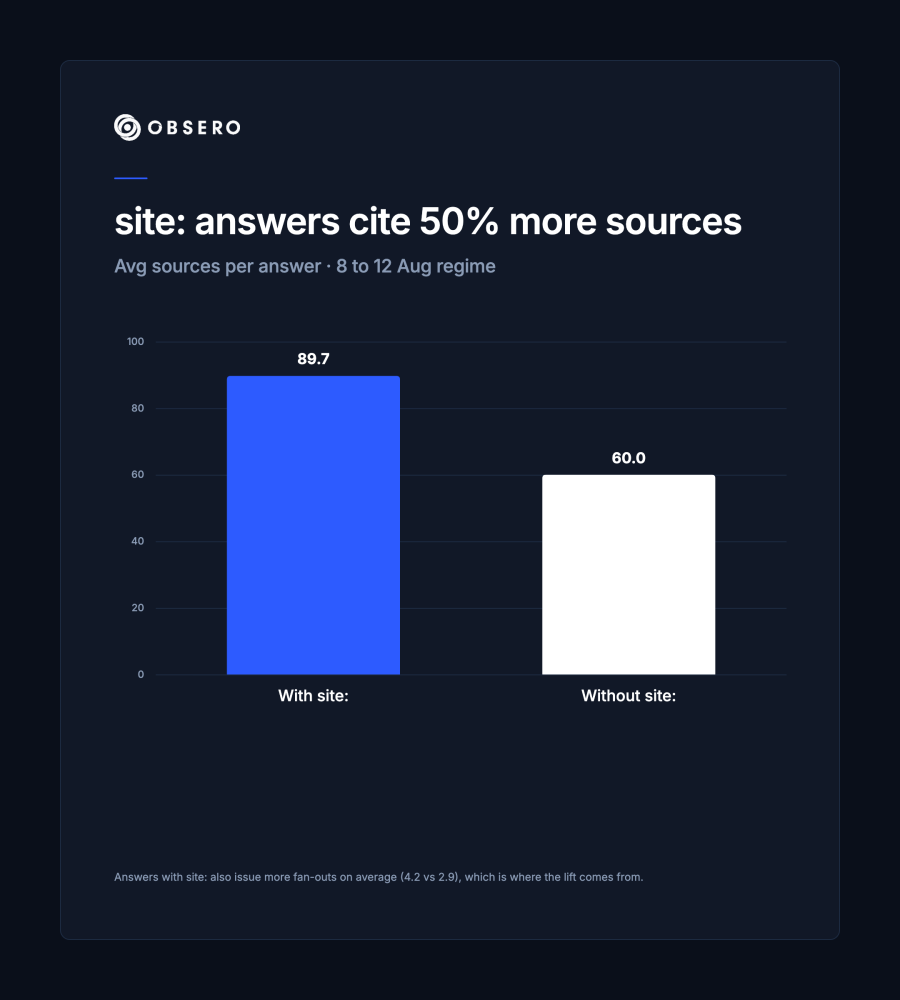
Answers using site: do cite about 50% more sources. But site: is not the cause. Those answers simply run more searches, and more searches means more sources.
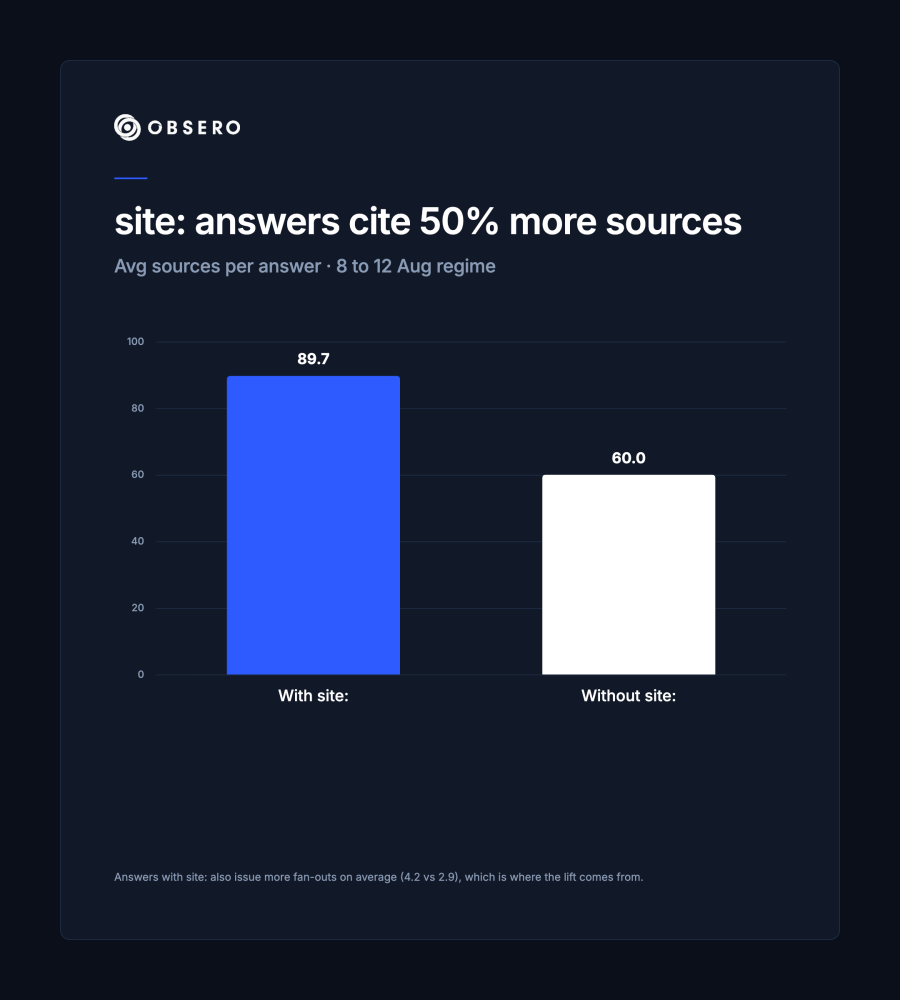
Answers that use site: cite about 50% more sources, 89.7 against 60.0 on average. More searches, not a better operator. Click to enlarge.
The real story is the shortlist. ChatGPT can only write "site:yourbrand.com" if it already knows and trusts your domain.
That is the big shift. Retrieval used to be a discovery issue. Now, on the prompts that matter commercially, it is an entity association one.
👖 What it looks like on a real brand
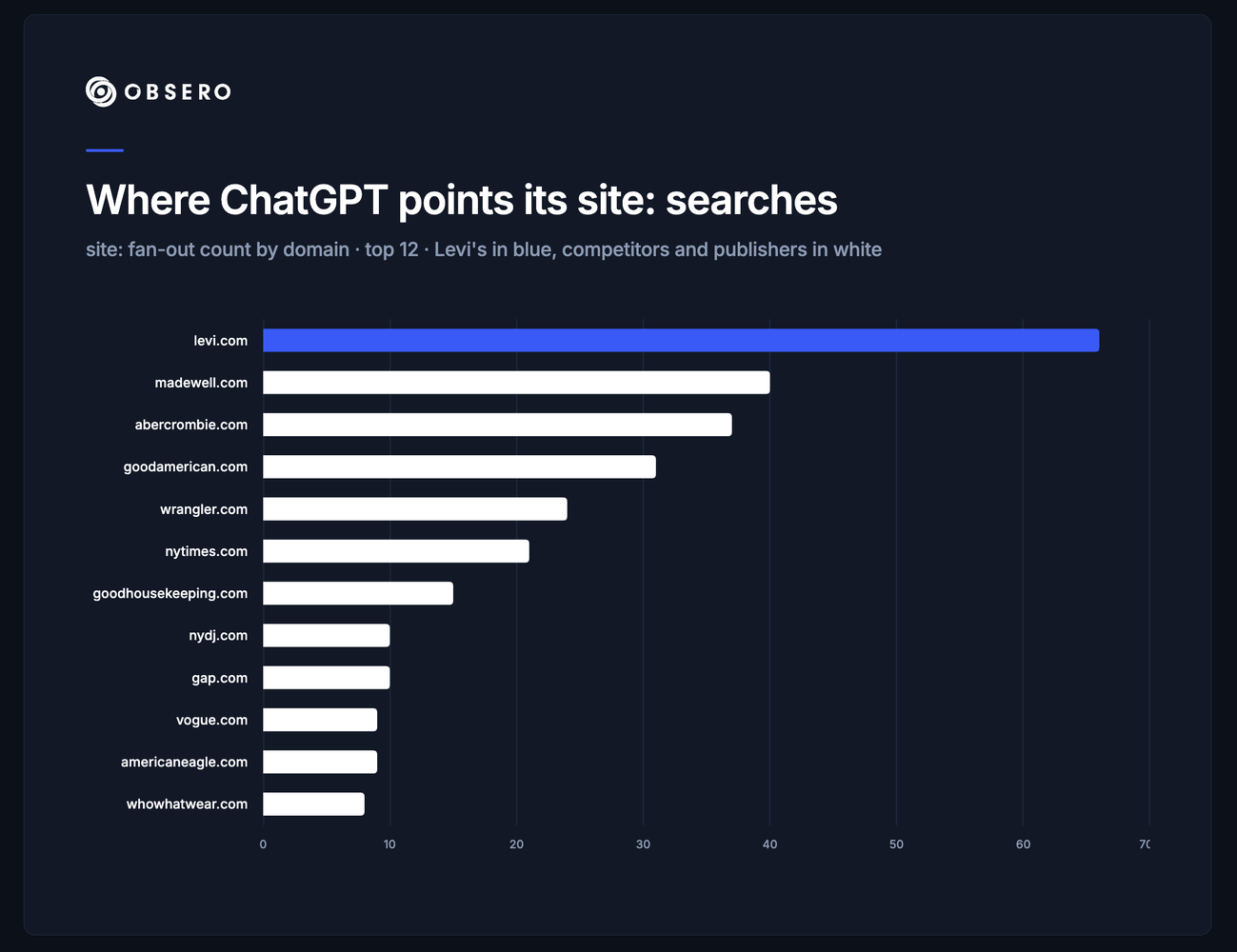
The Levi's cut. 1,505 fan-outs across 134 jeans prompts, and the domains ChatGPT went to by name. Click to enlarge.
We ran this on Levi's. Over 1,500 fan-out queries across 134 jeans prompts.
The site: behaviour is almost entirely a buying-mode thing.
Prompt type | Example | Answers using site: (5 to 12 Aug) |
|---|---|---|
Brand | "is Levi's good quality" | 25% |
Commercial | "best jeans for curvy women" | 21% |
Exploratory | "what shoes to wear with flare jeans" | 6% |
Those percentages are blended across the whole window, which includes three days before the change. Narrow it to "best X" prompts either side of the 8th and it goes from 1.9% of answers to 36.4%.
Style advice stays on the open web. Buying prompts get a dedicated and trusted shortlist.
The brands ChatGPT checked directly: Levi's, Madewell, Abercrombie, Good American and Wrangler.
The publishers it checked directly: The New York Times, Good Housekeeping, Vogue and Who What Wear.
If you know which sites ChatGPT targets through fan-outs, you have your new media hit list.
The shopping signal
On buying prompts specifically (where to buy, who sells X near me, how much are X jeans) site: usage went from nothing before 8 August to 11% of answers. Sources nearly doubled.
Before and after 8 August. Buying prompts went from no site: usage at all to 11% of answers. Click to enlarge.
And these are not review sites like Trustpilot. They are brand sites. Real examples using Obsero data.
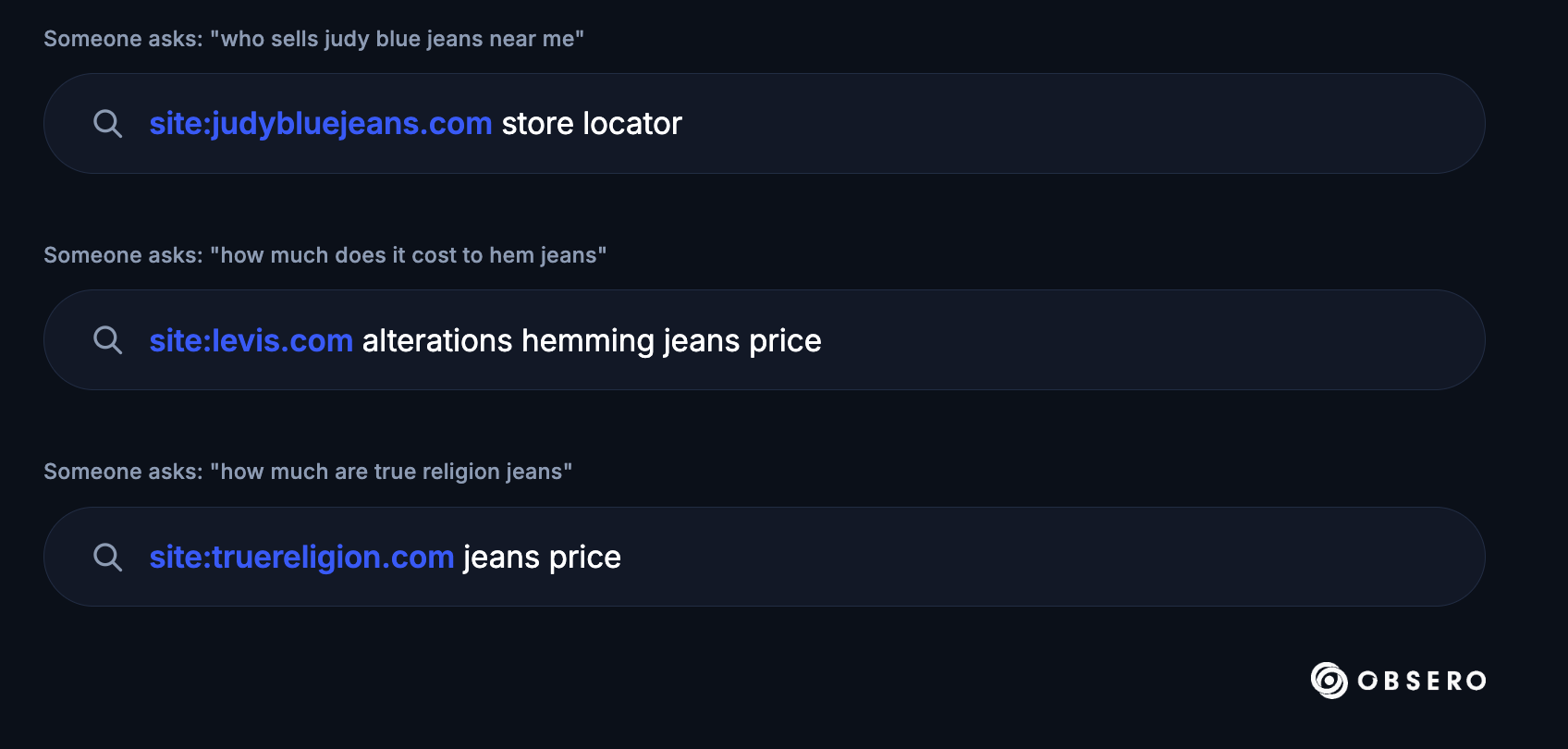
Real fan-out queries from the data. Store locators, hemming prices, product prices, all answered off the brand's own site rather than a review site. Click to enlarge.
ChatGPT is checking your prices, your stock and your store locator directly. If that information is buried in JavaScript, it cannot hand it to a potential customer.
Which means you can lose a potential customer without ever knowing it happened. There is no bounce rate to look at, because nobody got as far as your site. If your own assets are not optimised for this, you are not in the answer, and this is the sort of thing the fan-out data is for.
What it means for AI search
If you do PR. The value of that publisher tier has not changed. What has changed is that we can now watch ChatGPT searching those sites directly, with terms like "women's jeans", and using what comes back. Whether you are on that page shapes whether you make the answer, and how much ChatGPT can say about you when you do. Earned coverage is now a retrieval play, not just a reputation one.
If you do GEO or organic. Getting onto the trusted shortlist is an entity problem, not a content problem. Press coverage, consistent brand and topic association, and citations from sources the model already trusts.
If you run the site. Assume your own domain is the target of a site: fan-out. Pricing, stock and product detail need to be accurate and crawlable, in the HTML, not rendered client-side.
One point to remember. Fan-outs are generated at the time of the prompt. They are not fixed, they are not the same for everyone, and they move again every time the model does.
Organisations used to live and die by Google algorithm updates. Now it is model updates, and what changes under the hood filters straight through to buying behaviour, usually before anyone announces it.
One release took sources per answer up 5x and handed ChatGPT a shortlist of entities it trusts to answer the question. The person asking that question could be your buyer.
We tracked all of this in Obsero. If you want to see which domains ChatGPT site-restricts to in your category, the free trial is here.
Methodology
We capture ChatGPT answers for fixed prompt sets, along with the fan-out queries behind each one. Every capture records the model that served the answer, so the before figures are ChatGPT 5.5 and the after figures are 5.6. This is a model comparison, not a date comparison.
This piece uses 15,130 ChatGPT answers with fan-out data from 17 July to 12 August 2026, plus a single-brand look at Levi's: 905 answers and 1,505 fan-outs across 134 jeans prompts, 5 to 12 August.
site: usage means any fan-out query containing a site: operator. Sources means citations per answer. The prompt set did not change at any point, so the only variable is ChatGPT's behaviour.
As always, thanks for subscribing. I do love to hear your feedback, so please reply to this email and let me know what you thought of this edition.
If you want me to run the fan-out analysis on your category, reply and tell me the brand. I will have a look.
Until next week,
Andy
🗣️ This week's stories

What caught my eye in AI search this week.
Perplexity blocked Time's ads aimed at AI agents, calling them "deceptive", Digiday reports. Time started serving ads inside the markdown versions of its pages, written for bots rather than people. Perplexity confirmed it has blocked them from influencing its index. First real skirmish over who gets to put commercial content in front of a retrieval system, and it will not be the last.
Zoom is leaning on creators and journalists to shape its AI search results. A large B2B brand treating third-party coverage as a visibility channel rather than a PR metric. Same logic as the site: finding above, arrived at from the other direction.
Gemini's app passed one billion monthly users, The Information reports. Worth keeping in view while everyone optimises for ChatGPT.
Reddit is joining the S&P 500, CNBC reports, with shares up 11% on the news and inclusion landing on 18 August. The index story is not the interesting part. Reddit licenses its data to both Google and OpenAI, and it is one of the few domains AI answers keep returning to. What has actually been repriced here is the value of being a source models trust. If you still treat Reddit as a community channel rather than a retrieval one, that is the gap.
And right on cue, brands have started caring about Reddit and Redditors have not returned the feeling, the WSJ reports. Marketers have worked out that a well-received thread does more for AI visibility than anything on their own site, so in they pile. The catch is that the thing making Reddit valuable to a model is the thing brands erode by turning up. Communities can smell a marketer at fifty paces, and a downvoted brand post is worse than no post at all.