

In partnership with

Black Friday: Look Younger for 30% Less

Eye bags, wrinkles, and dark spots don't have to be part of your everyday look.
Particle Face Cream is the 6-in-1 anti-aging solution engineered specifically for men's skin, helping reduce visible signs of aging in just two minutes a day.
No complicated routines, no greasy finish. Just one powerful product trusted by over 1 million men worldwide.
For Black Friday, get 30% off with code BH30 and start looking your best for less. Plus, every order is backed by our 30-day money-back guarantee.
Don't miss our biggest offer of the year!
Meta's Muse launched in the UK this week, so I gave it a real task: cancelling the home insurance on the house we've just moved out of. It found everything it needed in minutes, then hit a wall that had nothing to do with the AI.
This edition covers what happened, how a personal assistant like Muse differs from an LLM like Claude, and what it means for brands whose customer journeys still end in a phone call.
I asked Muse to cancel my home insurance
I’m super disorganised when it comes to policy numbers, and finding them is always stressful because I can never get hold of them when I need them.
So an assistant that can dig one out and cancel the policy for me is exactly what I want from this stuff.
Muse went through my inbox and found Go.Compare renewal reminders first, worked out they didn't name the insurer, then kept looking until it found the LV= policy itself. It even flagged that the renewal date Go.Compare had given me didn't match LV's own email, which I hadn't spotted.
Then it hit the problem. LV lets you stop a renewal through an online form, but cancelling a policy mid-term means a phone call (and a £25 fee). Muse explained the difference clearly and offered to open the renewal form or write me a script for the call, and that was as far as it could go.
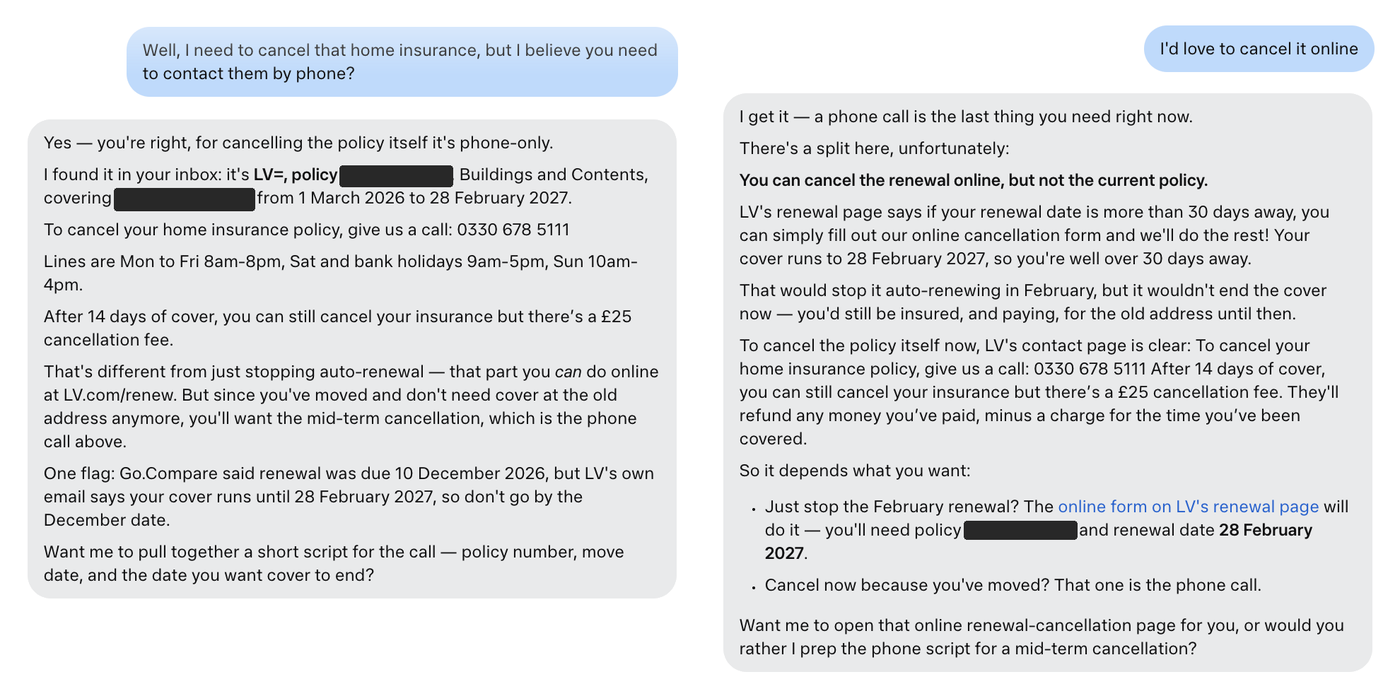
Muse found my LV= policy in minutes, but cancelling it still meant a phone call. Tap to enlarge.
That isn't the agent's fault. Muse did the hard part, finding the right policy across two companies' emails, in a minute. The blocker is LV, whose cancellation journey only works if a human picks up the phone.
That's the question every brand should be asking this week. If a customer's agent tried to buy, switch, claim or cancel with you, could it finish the job? I suspect for most brands the honest answer is still no.
But remember, it's still very early days. There are compliance, privacy and legal issues at play, as a brand needs to know who is really behind a request and that the customer meant it, so it isn't as simple as saying brands should let agents complete every task on their customers' behalf. That will change over time, and customers will notice which brands work it out first.
Since then, LV has emailed my cancellation documents, and Muse let me know without being asked, because it's connected to my Gmail.
Muse is growing fast, and the UK is market seven
Muse launched in the US in September and the UK is now its seventh market, after Canada, Japan, Singapore, Mexico and Australia, and its first in Europe. It's free to start, works on iOS, Android, the web and inside WhatsApp, and is open to anyone over 18.
The US numbers are big. Sensor Tower estimates 10.2 million US downloads in its first 40 days, against 3.7 million for ChatGPT and 200,000 for Claude over the same window. Worth flagging that Meta put 39% of its total ad spend behind Muse in October, so plenty of that growth was bought, and downloads aren't the same as people using it every day.
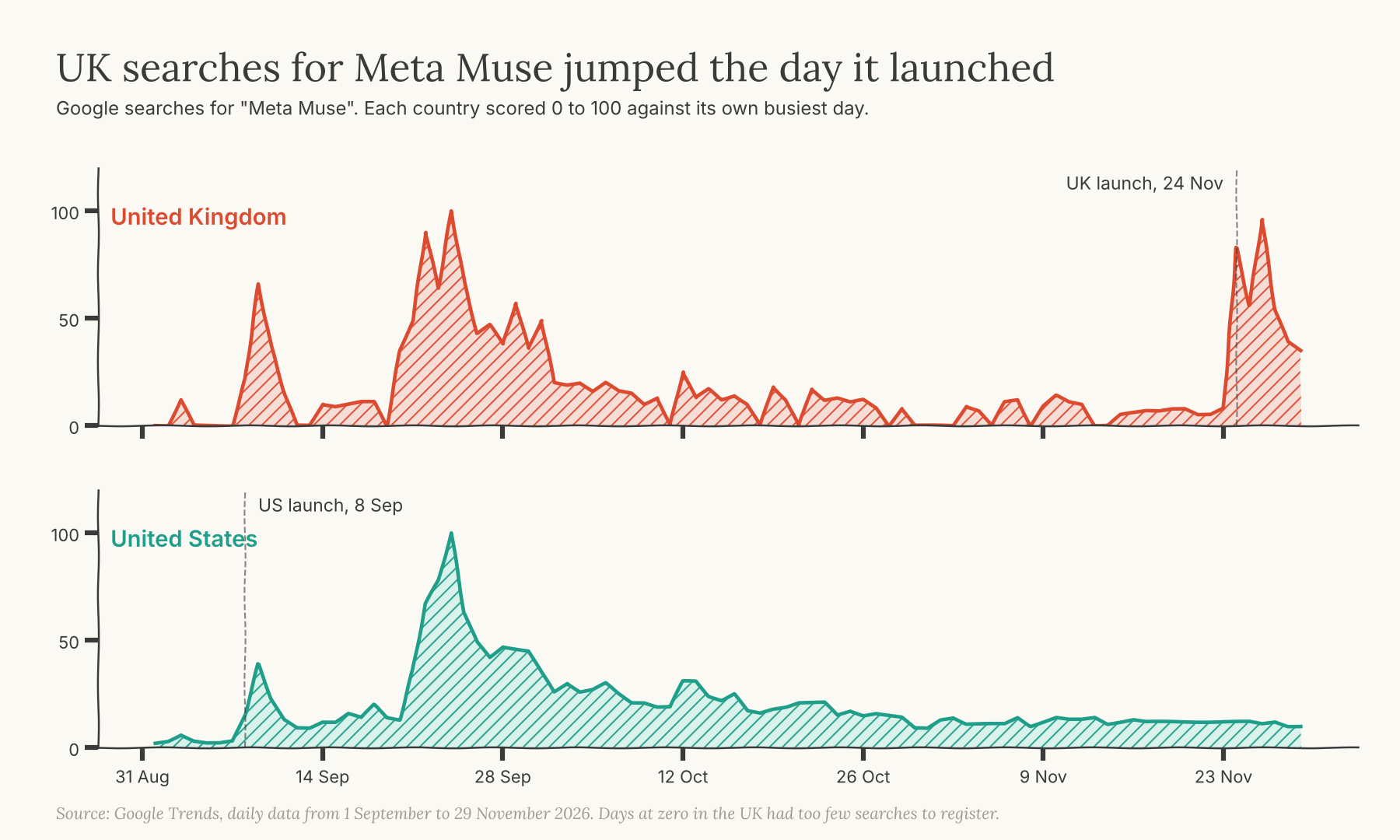
UK searches for Meta Muse jumped the day it launched here. Tap to enlarge.
UK searches jumped the day Muse launched here, almost back to the late-September peak when US interest hit its high. That earlier UK spike came from people reading about a product they couldn't download yet, which shows how far the US launch buzz travelled.
There's no UK download data yet as it's only been live a few days, so I'll come back to that.
Personal assistant vs LLM: what's the difference?
The line is blurring, because Claude and ChatGPT can both connect to your apps and take actions now. The real difference is what each one does by default.
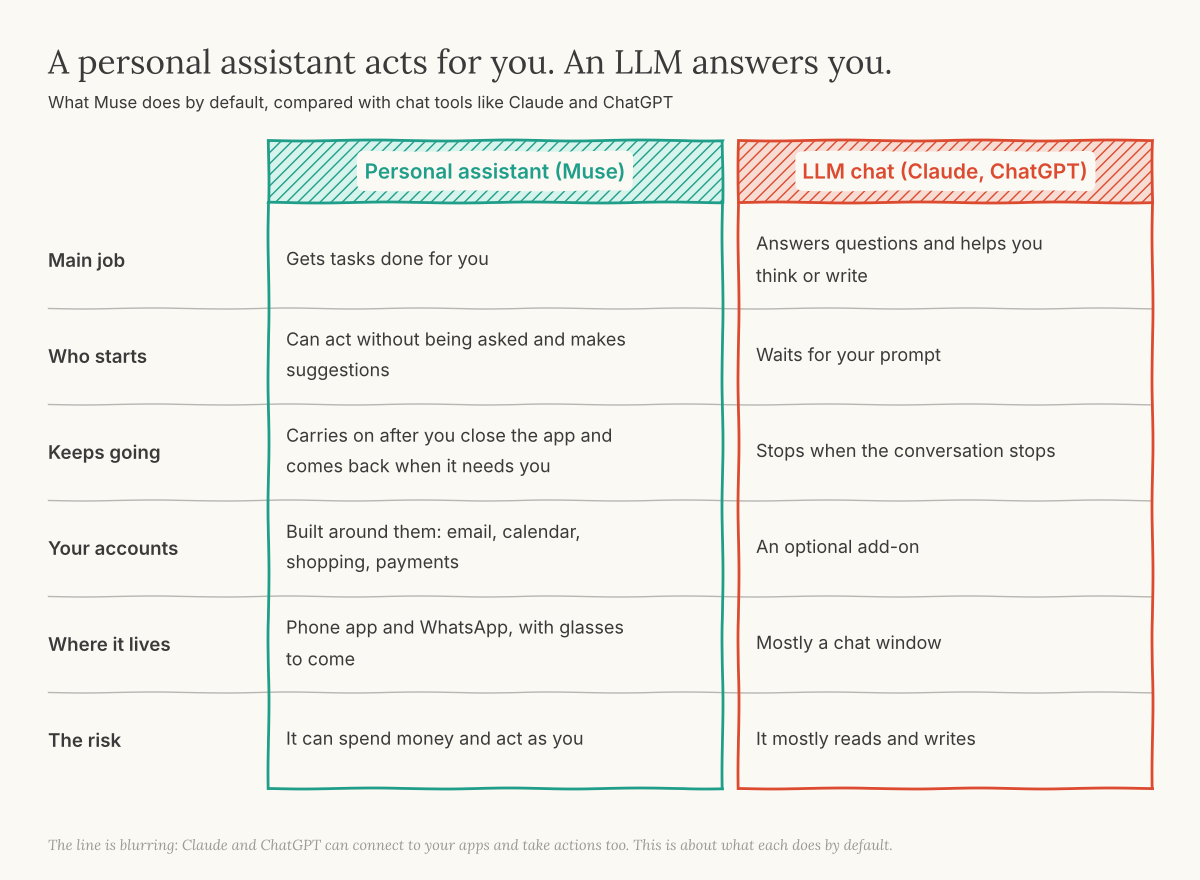
What Muse does by default, compared with Claude and ChatGPT. Tap to enlarge.
Muse isn't the first personal assistant I've tried. I connected Instinct, the invite-only agent you message like a contact, to my WhatsApp, and honestly it didn't win me over, as I struggled to see how I'd use it differently from Claude. Perhaps I should have given it more time, because I'm finding Muse extremely useful.
I also use AthleteData, a dedicated agent for my training data. It's meant to work like a personal coach, telling me what to eat and how to train based on what it can see from my devices, which is exactly the kind of always-on, connected help that separates an assistant from a chatbot.
Three kinds of question
It helps to split what people ask an assistant into three types, because each one needs something different underneath.
Knowledge. "How do I bleed a radiator?" Training data is fine here, as the answer doesn't change.
Fresh. "Who is the best footballer in the world right now?" This needs web search, and without it the model answers from whenever its training stopped.
Action. "Cancel my home insurance." This needs your accounts connected and, as I found out, a brand on the other end that lets an agent finish the job.
To show the difference between the first two, I ran the same question through Muse Spark, the model behind Muse, with web search off and then on.
Same model, same question, two different answers
I asked Meta's Muse Spark 1.3 the same question twice through the API on 27 November. The first time it answered from what it learned in training. The second time I let it search the web first.
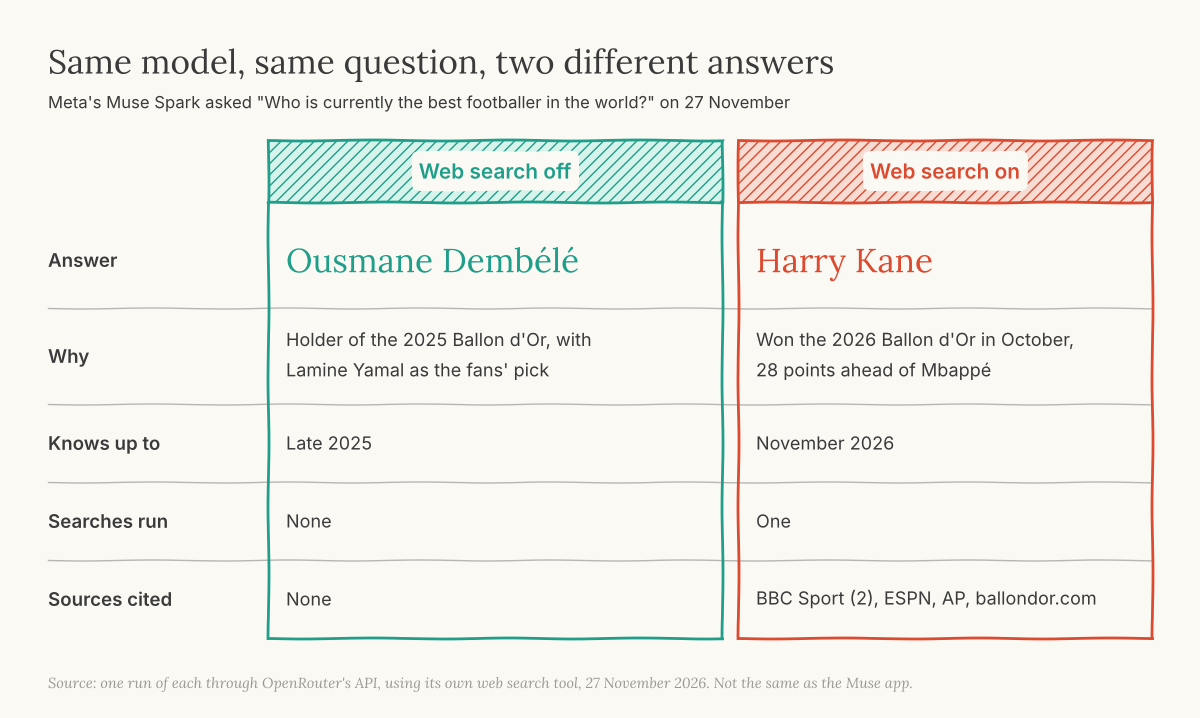
Without web search, Muse Spark answered from training data that stops in late 2025. Tap to enlarge.
The API isn't what you see in the app
That test ran through the API, which is the raw model. So I asked the same question in the Muse app as well, and it said Harry Kane, with the same 1,055 to 1,027 points gap, so the app is clearly searching the web by default.
What's different is everything around it. The API gave me a long answer with the full top 10 and five cited sources, while the app gave me five short lines and showed no sources at all.
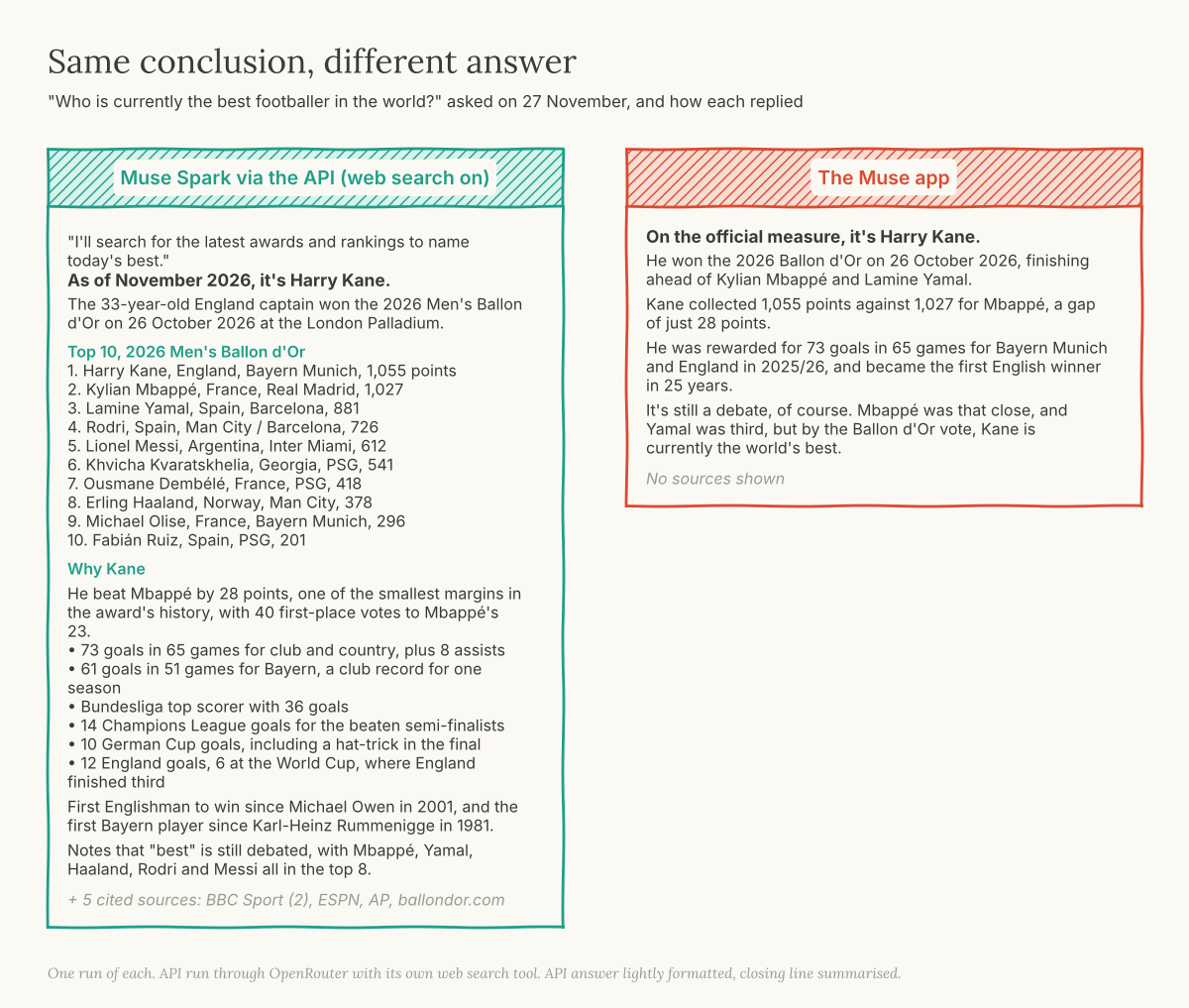
Both said Kane, but the API answer was long with five cited sources, and the app's was five lines with none. Tap to enlarge.
That's fine for a question like this, where there's one right answer. Now imagine asking about a trip. I'm heading to Edinburgh this week to see my co-founder Mike, and the Muse app knows where I am, can see my calendar and has access to my emails, so it can plan the whole thing around me.
Send the same prompt through the API and the model knows none of that, so you'd get a generic answer about getting to Edinburgh.
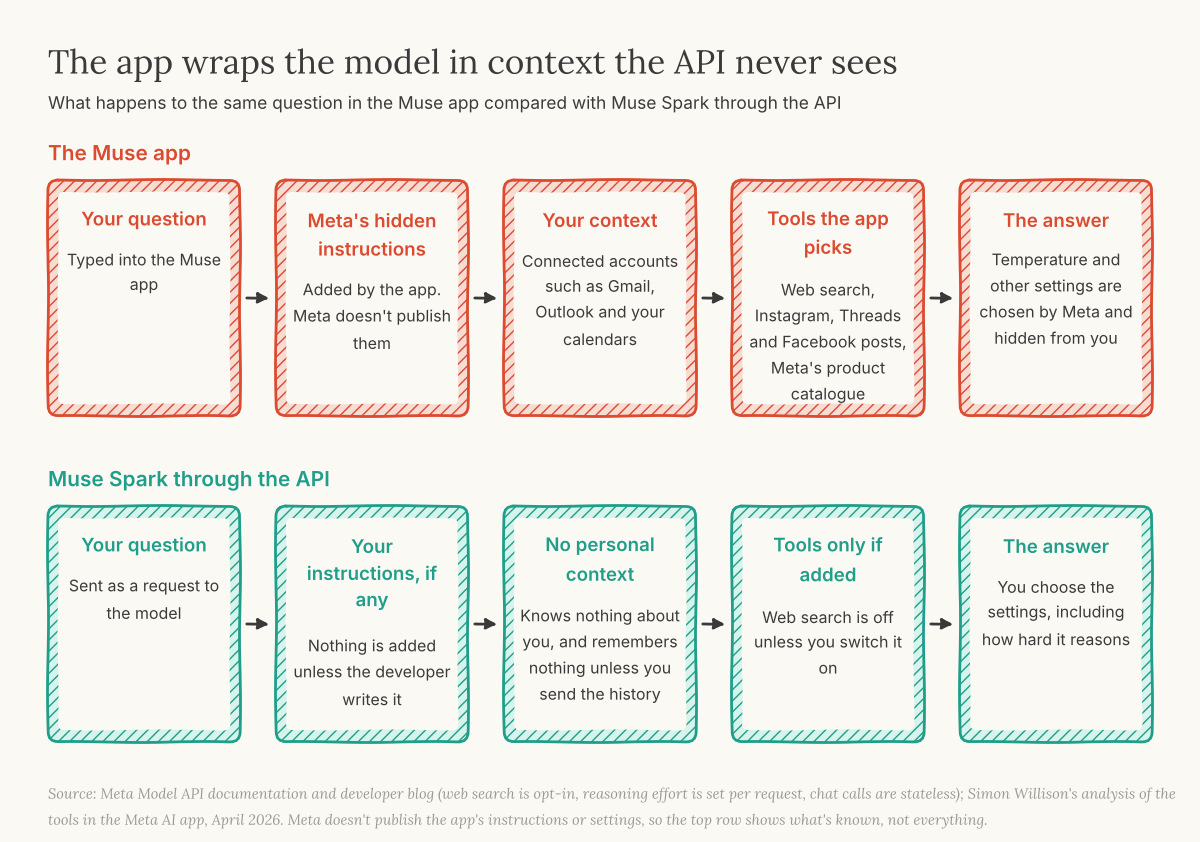
The Muse app adds instructions, your accounts and its own tools before it answers. The API adds nothing unless you do. Tap to enlarge.
So make no mistake, tracking the model through the API is directional. It tells you what the model knows and which sources it reaches for, but it isn't the answer Muse would give a real person. That gap between model and product is why we're careful about what we claim to track.
The privacy question
Muse is only as useful as what you connect to it.
It found my policy because it could read my inbox, and an assistant that books, buys and cancels for you needs your email, calendar and payment details to do any of it.
Meta has clearly thought about this.
Each user gets their own secure machine in the cloud, passwords and payment details are kept out of the agent's view, and Muse asks for approval before it sends an email or makes a purchase. But it's still Meta, and its record on data is part of why Meta AI took around 18 months to reach the UK after launching in the US.
My view is that Muse is only really worth it if you connect everything, and that's a big ask of any company, let alone Meta (we've been to this rodeo before).
Make that decision consciously rather than clicking through the permissions.
We'll be tracking Muse in Obsero
Over the next few weeks we're adding Muse Spark to Obsero.
To be clear, that's the model through the API rather than the Muse app, and we'll label it that way, because what the app shows a logged-in user with connected accounts is a different thing.
Keep an eye out for the first results here.
🗣️ This week's stories

What caught my eye in AI search this week.
ChatGPT is becoming a B2B research tool. OpenAI's latest usage report shows "obtain information about goods or services" rose from 1.69% to 2.92% of US work messages between Q1 2025 and Q3 2026, and pricing questions grew 2.6x, as Jimmy Park pointed out on LinkedIn. Together that's an 85% jump, taking product research from 11th to 5th of 165 work activities. OpenAI only publishes shares rather than message counts, so treat it as direction rather than volume, but if you sell something expensive and you're not in these answers, buyers researching your category won't find you. Jimmy Park on LinkedIn
Nine months of ChatGPT ads, in 31 slides. Juozas Kaziukėnas has pulled together the best overview I've seen of how OpenAI built its ad business, from a $60 CPM pilot in February to a $1 billion run rate by the end of August, now running in 89 countries with more than 150,000 sites using its conversion pixel. Two things stood out. Since the end of October, ChatGPT can rewrite your ad copy and even swap your landing page based on the conversation unless you opt out, and there's no prompt-level reporting, so you're bidding into a black box. Volume is growing, but early advertiser returns are mixed. Juozas Kaziukėnas on LinkedIn
Amazon is paying ChatGPT for shoppers it won't let ChatGPT see. Amazon is back running Black Friday ads in ChatGPT while still blocking OpenAI's crawlers, so ChatGPT links to Amazon search results rather than product pages and leans on deal sites for Amazon prices. eMarketer's Arielle Feger warns brands risk paying twice for the same customer, winning the ChatGPT recommendation and then paying again to beat Amazon's sponsored listings. Amazon wants the traffic, not to be aggregated. Digiday
Walmart is letting Muse shop, but on its own terms. For Black Friday, Walmart is routing Meta's Muse through its Agent Gateway, which lets it control how AI agents browse, add to basket and buy, with spending limits customers set through Agent Profiles. It's the opposite of my LV experience, and of Amazon, which blocked Muse in September. This is what being ready for agents looks like. The Verge
The search engine built for agents, not people. Exa, which counts Cursor and Cognition as customers, says it handles around 2 billion requests a month and has grown roughly 10x a year for three years. It raised $250 million at a $2.2 billion valuation in May, and Newcomer reported this week that it's in talks to raise again at around $7 billion. Agents want fast, structured answers rather than ten blue links or ads, and that's a very different search business to Google's. a16z
That's it for this week.
Have a good one.
Andy
