Ready to transform artificial intelligence from a buzzword into your personal revenue generator
HubSpot’s groundbreaking guide "200+ AI-Powered Income Ideas" is your gateway to financial innovation in the digital age.
Inside you'll discover:
A curated collection of 200+ profitable opportunities spanning content creation, e-commerce, gaming, and emerging digital markets—each vetted for real-world potential
Step-by-step implementation guides designed for beginners, making AI accessible regardless of your technical background
Cutting-edge strategies aligned with current market trends, ensuring your ventures stay ahead of the curve
Download your guide today and unlock a future where artificial intelligence powers your success. Your next income stream is waiting.
If you work in marketing, product, or tech - and want to keep pace with the shifts AI is driving across search, software and strategy - here’s what you need to know this week.
💬 Introducing ChatGPT Atlas –
OpenAI has launched its first browser, ChatGPT Atlas, currently limited to Mac users. It combines a familiar web interface with a chat panel that stays aware of what’s on the page, plus an experimental agent mode that can take limited actions on your behalf.
Early impressions are mixed - the “search” tab still routes users through Google, and some features feel unfinished, suggesting the team may have shipped quickly ahead of the holiday season. Even so, it’s a significant move that brings AI agents closer to everyday browsing and signals OpenAI’s first real step into the browser wars.
Key takeout: There have been rumours for some time, so it was no surprise when OpenAI announced the launch of ChatGPT Atlas - the company’s first browser.
When Perplexity launched Comet, it was suggested that OpenAI would follow suit and enter the browser wars - aiming to challenge Google Chrome’s dominance of the market.
So why does it matter? For starters, if OpenAI owns the direct relationship with the user, the potential value of its data becomes even greater - since Atlas’s optional “browser memories” feature allows ChatGPT to recall key browsing context to refine future responses (under full user control).
Secondly, this move could pose a long-term threat to Google’s advertising model. Atlas includes a simple web-search tab that lists results in the familiar “ten blue links” format - but without Google’s ads. The higher the adoption of Atlas, the fewer paid listings Google users might see.
That said, Chrome still commands about 60% of the global browser market share and it will take a major shift in consumer behaviour for users to abandon it in favour of Perplexity or Atlas. Even now, I’m writing this newsletter in Chrome, despite having both Comet and Atlas installed on my laptop.
My initial thoughts on Atlas are fairly lukewarm. It’s OK - it feels like a product in its early development phase, which I commented on this week on LinkedIn. I’ve no doubt it will improve over time. OpenAI likely didn’t want to miss the holiday season, which may explain why it shipped in its current state - and on Mac only.
💰 SoftBank greenlights remaining $22.5B OpenAI investment –
SoftBank has signed off the last part of its $41 billion commitment to OpenAI, valuing the company at around $260 billion. The deal is linked to OpenAI’s plan to restructure as a public benefit corporation, formalising its partnership with Microsoft and clearing the way for future investment.
Most of the funds will go toward the company’s soaring compute costs - expected to hit $16 billion next year and $40 billion in 2026.
The Information report ↗
Key takeout: One of the key focuses in the AI space right now is whether OpenAI can change its status from a non-profit to a for-profit organisation. This has been well documented through Elon Musk’s lawsuit against the company, which alleges a breach of its founding agreement, conversion of a charitable mission and misuse of its partnership with Microsoft.
SoftBank’s latest $22.5 billion funding approval brings the conglomerate’s estimated total investment to $30 billion and an estimated 13% ownership of the firm.
This suggests that OpenAI is on track to change its corporate status from a non-profit to a for-profit entity, paving the way for a potential IPO in the future.
The planned restructuring would convert the organisation into a single Public Benefit Corporation (PBC), with investors, employees and the original non-profit each holding traditional shares.
Given OpenAI has stated that it expects to spend $16 billion on compute costs in 2025 and $40 billion in 2026, it’s clear where this capital will be directed.
This is significant news as it implies OpenAI is likely to succeed in changing its corporate governance structure. That shift could open the door to a clearer path toward an IPO and liquidity for shareholders, major investment in compute and infrastructure, tighter commercial alignment with Microsoft, a governance reset and faster progress toward AGI and product expansion.
📉 AI Enigma: search traffic drops to sites, but revenue doesn’t-yet -
A number of brands report lower site traffic as users shift to AI chat and Google’s AI Overviews - yet revenue remains resilient for many non-publishers. Companies are reallocating spend (more streaming and paid search), optimising for GEO (citations, ecosystem optimisation e.t.c) and rewriting content to be AI-parsable (clear summaries, FAQ-style answers).
The Information analysis ↗
Key takeout: AI Search takes centre stage once again as The Information reports on hotel chain Tafer Hotels & Resorts, which saw traffic fall by 25% - yet revenue remained steady.
The company’s CMO, Max Gomez Montejo, suggested that lower-quality traffic - for example, searches like “Cancun weather” - has been lost to AI Overviews providing instant answers, while higher-intent users still reach the site to book directly.
It’s a simplistic take on the user journey, but it reflects a broader pattern we’re starting to see across AI search ecosystems: traffic is dropping because the answer is now delivered directly to the user.
Montejo focused on weather-related queries, which are low-value - and it’s clear why losing them doesn’t impact the bottom line. But that misses the point about potential customers now turning to ChatGPT to plan a holiday or compare different hotels.
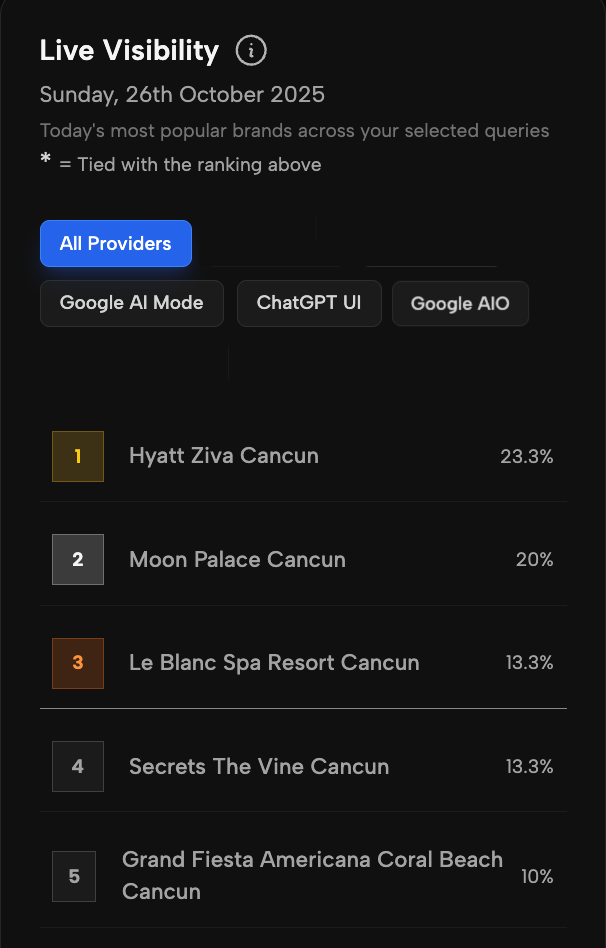
In Obsero, looking at a set of non-branded prompts focused on discovery (“Which is the best hotel to stay in Cancun?”) and consideration (“Compare beachfront resorts versus city hotels in Mexico”) from US users based in New York, we’re observing similar intent-driven behaviour.
From manual observation, none of the top five brands in terms of visibility appear to be owned by Tafer - so there’s a clear opportunity to invest in AI Search to maintain and grow revenue as user behaviour and technology continue to shift.
The key sources cited by Google and ChatGPT aren’t surprising: Trustpilot ranks highest, followed by Expedia. Interestingly, Travel + Leisure is the third most-cited publisher in this space - one I hadn’t come across before. From a digital PR perspective, it’s a publisher worth exploring for potential partnership opportunities.
The shift is happening right now - and brands need to adapt or risk falling behind.
Source: Obsero.ai, October 2025
I was sent the following by my Obsero co-founder, Mike Logue - a collection of important essays written by Paul Graham of Y Combinator over the years, focused on startup growth and what founders should consider when building and scaling their apps into successful consumer products. A recommended bookmark for entrepreneurs.
Thanks to each and every one of you for subscribing and reading. Have a great week!
Andy
Smarter visibility in AI Search starts here.
Track, analyse and optimise how your brand appears in ChatGPT, Google AI Overviews and Perplexity.
Actionable insights. Competitive benchmarks. Built for zero-click discovery.
Be Datable is written by Christian J. Ward, Chief Data Officer at Yext and co-author of Data Leverage. It focuses on the link between AI success and data strategy - helping readers move beyond hype to understand that effective AI starts with well-structured, high-quality data. Each edition shares practical frameworks and insights on how to make your organisation truly “datable.”
Be Datable
Your AI Strategy is Your Data Strategy
🎯 Hey content creator!
Thinking about launching your own newsletter? I recommend Beehiiv - it’s built for creators, with all the tools you need to grow: